
The CMS is unbundling. The DXP is rebundling.
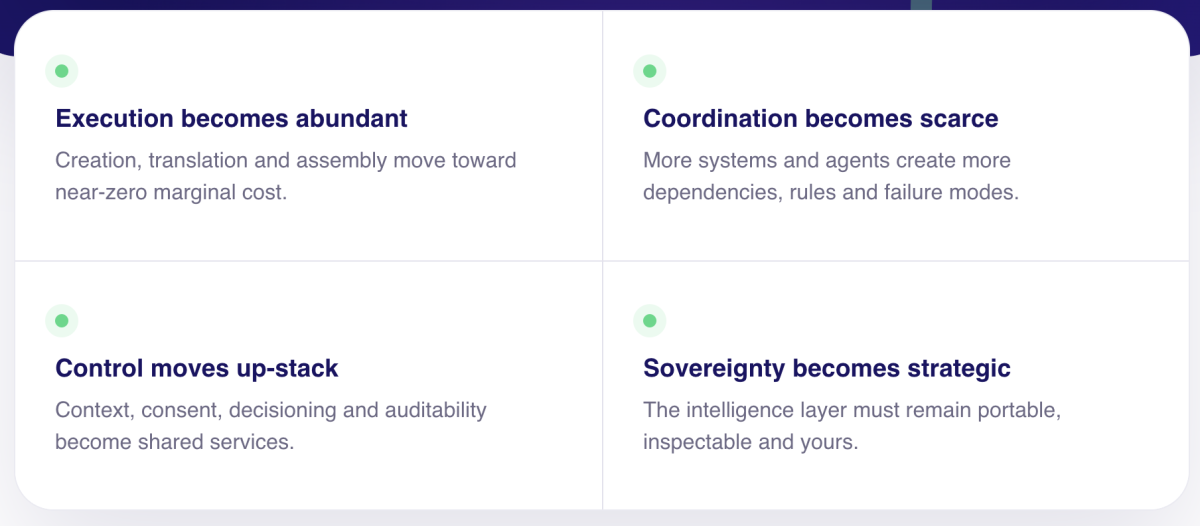
AI makes execution cheap. It makes context, coordination, governance and sovereignty more valuable.
The CMS is being unbundled into a control plane and an execution plane. Follow that logic across the full customer experience and something else becomes visible: the DXP is being rebundled as the shared control plane for an organisation’s digital promise.

The CMS controls content. The DXP controls the experience.
Dries Buytaert’s essay “AI and the great CMS unbundling” makes an important distinction: AI is separating the execution plane of a CMS from its control plane.
The execution plane creates, assembles and delivers. The control plane decides what is structured, approved, reusable, trusted and allowed to go live.
I agree with that distinction. I also think it explains something that has confused our market for several years: why the DXP, after being pulled apart by composable architecture, is now being put back together.
Not as the old suite. Not as one vendor trying to own everything. But as an experience control plane.
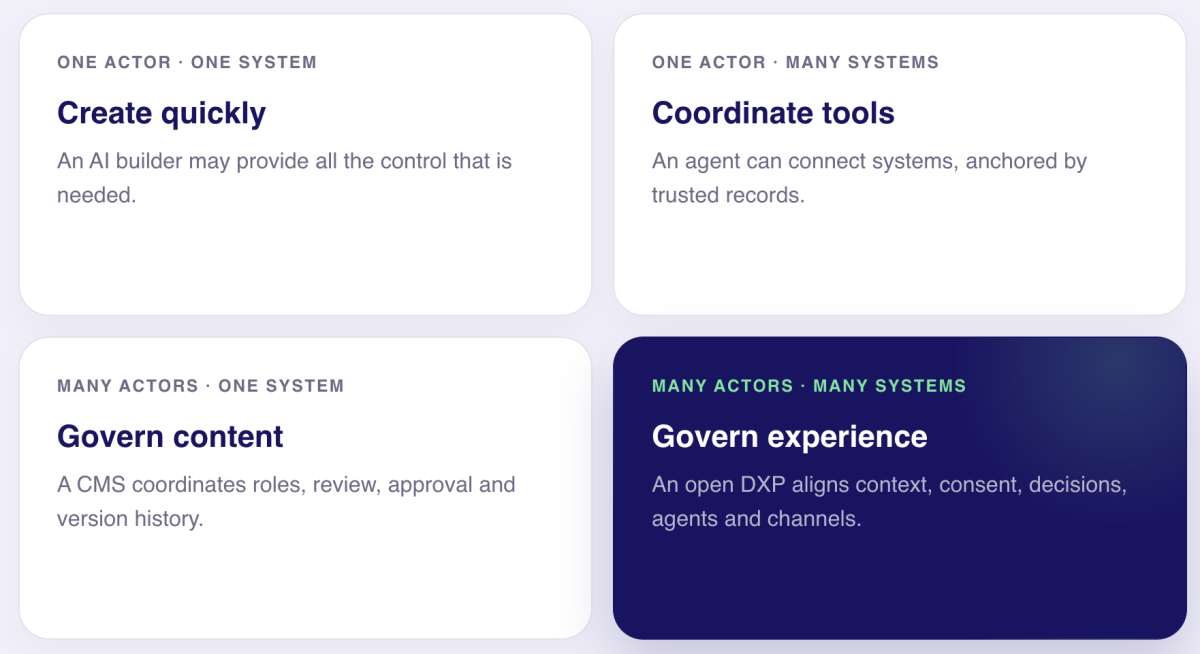
Dries asks two useful questions: how many people or agents are involved, and how many systems need to use or trust the work?
With one person and one simple website, an AI builder may be enough. Add more editors, reviewers and agents, and the CMS becomes essential. Add more channels and systems, and the need for a trusted source grows again.
But in an enterprise, content is only one part of the experience.
The experience also depends on identity, consent, customer data, segments, products, inventory, campaigns, service history, analytics, business rules and, increasingly, the actions of AI agents.
A CMS can answer: Which content is approved?
A DXP must answer a broader set of questions: Which experience is allowed, for whom, in which context, through which channel, using which data, and who remains accountable for the result?
That is why the top-right corner of the CMS discussion, many people and agents working across many systems—naturally becomes a DXP discussion.
The CMS is the control plane for content. The DXP is the control plane for the promise an organisation makes to its users and customers.
The coordination test
One actor, one system: create quickly. An AI builder may provide all the control that is needed.
One actor, many systems: coordinate tools. An agent can connect systems, anchored by trusted records.
Many actors, one system: govern content. A CMS coordinates roles, review, approval and version history.
Many actors, many systems: govern experience. An open DXP aligns context, consent, decisions, agents and channels.
The composable correction was necessary
The DXP market deserved to be unbundled.
The first generation of DXP suites became too large, too slow and too licence-driven. They promised one integrated experience, but often delivered a long implementation, expensive upgrades and a relationship that was difficult to leave.
Composable architecture was a necessary correction. It gave organisations choice. It let teams select a better CMS, a better marketing automation platform, a better commerce engine or a better customer data platform. It moved power away from the suite vendor and back toward the architect and the customer.
But the business outcome never became composable.
A customer does not experience your architecture diagram. A citizen does not care which system owns the form, which tool sends the email or where the consent record is stored. They experience one organisation.
So the integration work did not disappear. It moved to the customer.
Every new product brought another API, identity model, permission model, release cycle, audit trail and support contract. Marketers gained best-of-breed tools, but also more tabs. Developers gained freedom, but also more glue code. CIOs reduced one form of lock-in and inherited a growing coordination burden.
Composable solved an ownership problem, then created a coordination problem.
AI does not remove that coordination problem. It multiplies the number of actors inside it. Every agent is another user. Every agent action is another integration. Every autonomous workflow is another policy surface that must be observed, explained and, sometimes, reversed.
AI pulls the bundle back together
AI is collapsing the cost of execution.
Copy generation, translation, image adaptation, code, page assembly, campaign variants, audience analysis and workflow automation are rapidly becoming abundant capabilities. What looked like a separate software category a few years ago increasingly becomes a feature of a model or an agent.
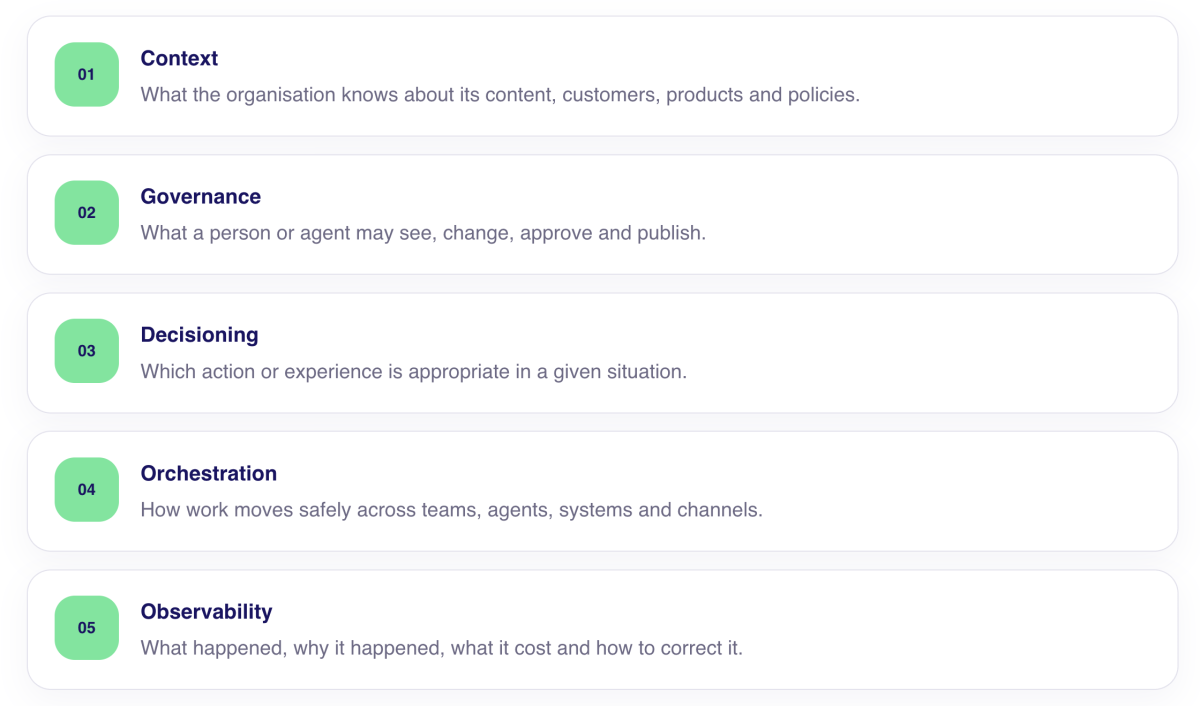
When execution becomes abundant, value moves to the things that are still scarce.
Context
What the organisation knows about its content, customers, products and policies.
Governance
What a person or agent may see, change, approve and publish.
Decisioning
Which action or experience is appropriate in a given situation.
Orchestration
How work moves safely across teams, agents, systems and channels.
Observability
What happened, why it happened, what it cost and how to correct it.
These are not isolated features. They are shared services. Every channel needs them. Every agent needs them. Every team needs to trust them.
That creates a strong pull toward a common platform layer.
An agent without context is a demo. An agent without governance is a risk. An agent without observability is a liability.
The bundle returns because shared context and control become more valuable with every system and every agent connected to them.
Rebundle responsibilities, not codebases
This does not mean going back to the monolith.
The next DXP should not be one enormous application that performs every task. It should be a coherent control surface over components that remain replaceable.
Composable underneath. Coherent above.
The CMS can remain the trusted content system. Marketing automation can remain specialised in journeys and messaging. A CDP can maintain customer context. Commerce can own transactions. Analytics can measure behaviour. Different models can handle different AI tasks.
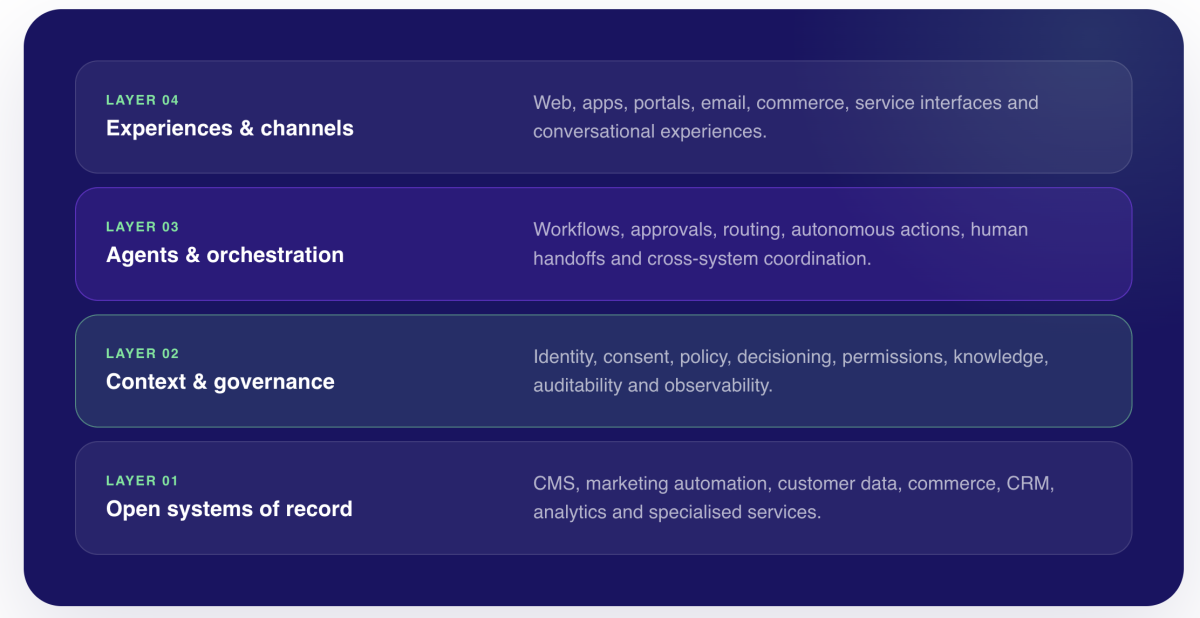
The DXP rebundles the responsibilities that must be shared across them: a common context layer; common identity, consent and policy rules; governed access for people and agents; decisioning and orchestration across systems; shared observability and lifecycle operations; and one usable workspace for the teams responsible for the outcome.
The DXP does not have to execute everything. It has to make the whole system act like one responsible organisation.
That is why I increasingly see the DXP less as a box and more as an operating system for digital experience.
Experiences and channels
Web, apps, portals, email, commerce, service interfaces and conversational experiences.
Agents and orchestration
Workflows, approvals, routing, autonomous actions, human handoffs and cross-system coordination.
Context and governance
Identity, consent, policy, decisioning, permissions, knowledge, auditability and observability.
Open systems of record
CMS, marketing automation, customer data, commerce, CRM, analytics and specialised services.
Rebundling is inevitable. Lock-in is optional.
There are two ways this market can rebundle.
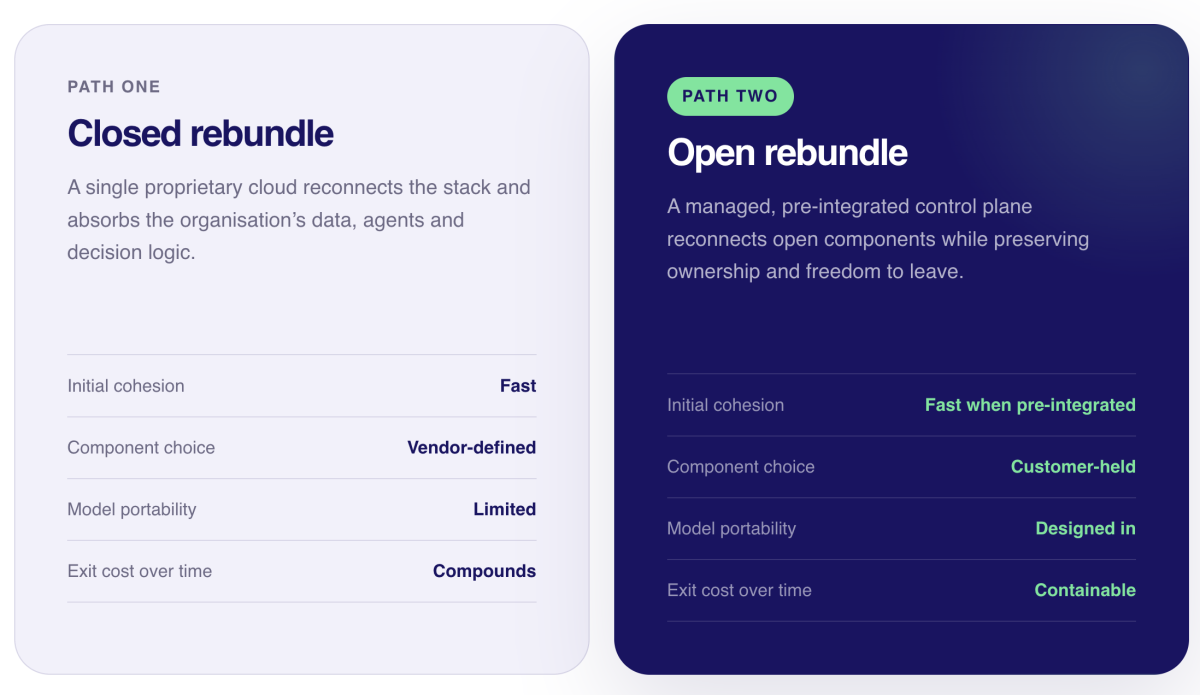
A closed suite can pull content, data, campaigns, analytics and agents into one proprietary cloud. That can create a convenient experience, especially at the start. But AI makes the lock-in deeper than before. It is no longer only the CMS or the data that becomes difficult to move. It is also the knowledge layer, the agent runtime, the prompts, the policies, the decision logic and the operational history.
The exit problem expands from one product to the intelligence of the organisation.
An open DXP takes another route. It can offer the benefits of integration while keeping the substrate open: open-source systems, open APIs, portable data, model choice and interoperable agent protocols. It can be pre-integrated and professionally operated without making the customer captive.
Open does not have to mean do-it-yourself. And integrated does not have to mean locked in.
The real alternative to the closed suite is not forty browser tabs and a collection of APIs. It is an open bundle: cohesive enough to operate, modular enough to evolve and sovereign enough to leave.
Freedom to leave is not a slogan added after the architecture is finished. It is an architectural requirement.
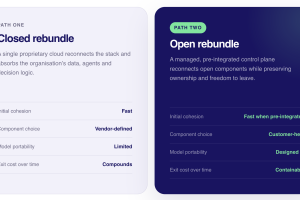
Closed rebundle
A single proprietary cloud reconnects the stack and absorbs the organisation’s data, agents and decision logic. Initial cohesion can be fast, but component choice is vendor-defined, model portability is limited and exit costs compound over time.
Open rebundle
A managed, pre-integrated control plane reconnects open components while preserving ownership and freedom to leave. Cohesion can be fast when the platform is pre-integrated, while component choice remains with the customer, model portability is designed in and exit costs remain containable.
You may already be paying for a DXP
A practical test is simple.
Do several teams or agents create, review or activate experiences?
Is the same content reused across web, email, apps, portals or assistants?
Do customer data and consent affect what may be shown or sent?
Do multiple systems participate in the same journey or outcome?
Must you be able to explain, approve, audit or undo AI-driven actions?
When several of these are true, a DXP is not a marketing category. It is an architectural reality.
You can implement that reality as a coherent platform, or you can pay for it indirectly through integration debt, duplicated rules, fragmented data and manual coordination.
The bundle exists either way. The question is whether it is designed.
The DXP that comes next
The next DXP will be AI-native, but model-agnostic. Agentic, but governed. Composable, but pre-integrated. Sovereign, but operationally easy. Open, but enterprise-grade.
It will give marketers and service teams one coherent environment in which to create, decide and act. It will give developers open rails rather than a closed box. It will give CIOs and CISOs accountability, portability and control. And it will give AI agents the context and boundaries they need to become useful colleagues rather than unpredictable automations.
Dries’ unbundling thesis explains why the CMS remains essential. Take it one layer further and it explains why the DXP is returning.
AI unbundles execution. Enterprise reality rebundles responsibility.
The future is not simply monolith versus composable. It is closed rebundling versus open rebundling.
I know which side I am betting on: coherent on the outside, composable on the inside, open underneath, with the customer holding the keys.
AI creates abundance. A sovereign open DXP makes that abundance useful, governable and yours.
That is the DXP I believe in. It is also the one we are building toward.
Rebundle the outcome. Keep the freedom.
AI creates abundance. A sovereign open DXP makes that abundance useful, governable and yours.
Read Dries Buytaert’s source essay.
Source: Dries Buytaert, “AI and the great CMS unbundling,” published 16 June 2026.
Add new comment